Wednesday, February 06, 2013

International School of Rumbai, Sumatra: Not just Monkeying Around.


Ever look out at the sliders, swingers and tag players on a lively playground and think, what a bunch of monkeys?

At the International School of Rumbai, playground monkeys are not just metaphorical.  The school’s campus, carved from the jungle by an oil company (now Chevron) 50 some years ago has become a sanctuary for wildlife – short and long-tailed macaques,  gibbons, monitor lizards – as the jungle around the compound has been clear cut to make room for palm tree plantations. 

Although the macaques beat us to school in the morning, they went back to their forest to nap while the students of Rumbai made poetry about dim sum, recess, conflicts, people, places and experiences in and out of the classroom.  I don’t want to say that ONLY at an international school might a first grader write a refrain poem about dim sum, because there may in fact be a Chinese dumpling enthusiast in Houston or Salt Lake City.  I’m just saying I haven’t met one yet. This is what makes working in international schools a constant surprise.
 

We wrote about what was real and closed our eyes to search our imaginations for ways to stretch our observations.


The classes are small and the school itself has only 65 students.  They come together every morning for a meeting and a few quick exercise moves lead by a rotation of students.  Teachers, imagine this: you teach for 10 or so students for the morning, walk home for an hour lunch and then come back for the afternoon?  People who teach at small schools such as this have made a quality of life decision to destress.
 

The middle schoolers gave us a percentage poem to help us remember them and then a second poem, explaining what our bus trip to visit their sister school in Duri. 
 

Thank you to all the teachers and students in Rumbai for a grand and memorable visit.

Sunday, February 03, 2013

Pasir Ridge International School


Coming around again to something brand new is traveling to a foreign port and being met by familiar faces.  Didn’t we meet before in Seoul?  Didn’t we have dinner in Kota Kinabalu? I remember you from Cairo!

Michael and I have been on the international circuit long enough that we are more certain to be greeted by folks we’ve met before than not.  Still this trip was extra special as this is the third time we have had the privilege of working for Principal Seamus Marriott and his dynamic teaching wife Theresa.  First meeting in Wisconsin, traveling to work at their school in Shanghai, followed by Cairo American College and now Balikpapan, Indonesia. 

Pasir Ridge is a small school by any measure except quality, where they are overflowing, stacked to the ceiling tiles and busting out the windows. 

But, by far the best part of the week was Friday afternoon assembly -- they came with poems about happiness, anger and frustration, from the points of view of slaves, sun bears and the Empire State Building. They spoke with the kind of confidence that comes from feeling safe, to parents, teachers and their classmates.  Every voice blending into a harmonious chorus celebrating individuality. Thank you Pasir Ridge, Balikpapan.


Sunday, January 06, 2013

Changing Perspectives


When Michael Salinger and I were teaching in Morocco, we were introduced to a new fashion trend.  Teen girls were wearing the shortest of short shorts over tights and patterned stockings.  They obviously had studied the student handbook, which probably said "no bare legs up to your bum" or some such language, and found a creative way to stay in compliance.  They saw their window, and they took it.

The CCSS are market driven, of that there is no doubt.  But much like commercials in between segments of a sitcom (say, the sitcom that masquerades as school reform) people will learn to live with them the same way we have learned to live with fast food, once size fits all, and bigger is better -- with a healthy dollops of irony and skepticism and a little of what Michael calls middle school logic, "Hey, they didn't say we couldn't!"

So, until the next set of standards is cooked up to be stuffed down the digestive tract of public education, creative teachers will be heartened to find that although the CCSS don't specifically mention writing poetry in the W strand, they don't say you can't write poetry as (say) informational text.  They don't say you can't write a poem to demonstrate understanding of point of view.  They don't say you can't write a persuasive poem.  What the heck is a persuasive essay anyway? Certainly that's more of a stretch than a persuasive poem -- persuasive essays don't even exist off the educational verbal playground.  Poets have been trying to change hearts and minds since the days of foot-binding.  If it was the intent of the marketing folks who created these standards to eliminate poetry from the curriculum, the CCSS are a pitifully poor attempt.

In RIT 4, it says that students should "interpret words and phrases as they are used in a text, including determining technical, connotative, and figurative meanings, and analyze how specific word choices shape meaning and tone."  But in the fine print it says, that these analyses will "serve as models for students' own thinking and writing."  In other words, it is in the reading standards that the CCSS recommend using poetry as writing models, not the writing standards.

That's one window.  There are plenty of others.  Those of us who know that poetry works as a means to lead young people to a better understanding of their world need to remain confident that jamming poetry into the windows of these standards will help young people grow in both their communication and thinking skills.  Subversive infusions of poetry may even help kids on those bubble tests that no one has ever linked to success or happiness in life.  It remains part of our jobs to open the windows and let poetry work in to work its magic.

Tuesday, January 01, 2013

Baby Talk 2013


I recently wrote on a friend's Facebook wall, joking about emotional displays in public, that I had thrown up while watching Bonnie and Clyde. True story, no flu symptoms. 

I have no trouble suspending disbelief in a movie. If someone sets a table for tea, I lean in to blow steam from the cup. When the bullets started flying into their roadster tearing Warren and Faye to pieces, I jumped around in my seat, taking it all to heart (and to the gut). That's when it happened. Barf.

Fact is, it was 1967, I was a teenager and had never seen anything like that before on the screen. I'd seen Spartacus, but that was from a time, oh like, a couple of hundred years before 1967, right?

Sometimes at school visits I ask kindergartners if the have seen Star Wars, and 94% of them say yes (the other 6% are braiding each other's hair, so this is not exactly a scientific sampling). This means they have seen bullets tear through bodies, dismemberment, decapitation, torture, and every type of mayhem very creative Hollywood brains can invent to visit upon the human body. Before they are six.

There is no putting this huge rhino back in the closet. It's out there. But I wonder if we maybe need to be having some more conversations about it. Instead of laughing at each other when we cringe (yes, I still cringe and get laughed at) and admonishing each other to toughen up, maybe we need to talk a little to kids about the differences between film and reality. That head shots aren't necessary, that people have families who love them and that's one reason you never shoot first and ask questions later. That people are people and that real life isn't a carny shooting gallery.

Michael's son Frankie was a primary student  on 9/11/2001. A few days after the tragedy, he asked, "when will the bomb hit here?" We thought he understood, we thought he felt safe, we thought he wasn't paying attention. He was.

Even though 1967 is to 2013 what 1921 was to 1967, kids listen when we tell them stories. When we tell them how it was and how it really is. Heros don't spray the room with bullets and then get the pretty girl and live happily ever after. Being strong means to be able to say the words, "I don't like that," not get off a head shot.
 
When we take time to explain the difference between fiction and reality to kids, they get it. But we have to say the words. We can't assume they already know or that they are not paying attention. At home, at school, everywhere. We have to say the words.

Frank and his brother Max grew up to censor movies for me, as in, "don't come in here right now Sara, this movie will upset you." Last weekend, my grandson Dan said something similar about a video game. This "protect Sara," action has become a family story to chuckle about. 

Only, it's not a joke. Not really. It is and should be a discussion starter.

This year my resolution is to follow up my question about Star Wars with, "you know, that really isn't how most people settle fights. Mostly we don't shoot and chop one another to pieces. Mostly we talk things over. Sometimes we even use poetry. Here, let me show you."


Saturday, November 10, 2012

Hate Was Not his Normal State


War is the Fiercest Art

The Luc Bat poet knew
His country broke in two, therefore
He had to go to war.
His wife and child, heartsore, waved bye.
The poet dared not cry.
He needed a clear eye to spill
Blood, strangers he must kill
To stay alive until the time
He could again in rhyme
Make images sublime. His heart
Was wracked and torn apart.
War is the fiercest art. Trading
Pen for gun, evading Death,
Armies invading. This hate
Was not his normal state.
One question would frustrate, for he
Knew not this enemy.
Might you love poetry?
     I, too.
sara holbrook
ed. Lee Bennett Hopkins

When Lee sent out the invitation to poets to write poems to chronicle each of the wars that America has engaged in over its lifetime, I remembered a story I had seen on 60 Minutes (as I recall).  It told the story of an American soldier who found a book of poetry on a dead Vietnamese soldier, poetry that he himself was writing during the prolonged tragedy that we call the Vietnam War and that the Vietnamese call the American War.

In the story, the American soldier traveled back to Vietnam 30 years later to return the book of poetry and a photograph to the Vietnamese soldier's family.  I can't find a link on line, but I remember wondering as I watched the narrative: what would that be like?  A poet called to war?  In the US, some men and women served, but most did not.  There were no such choices to be made for the Vietnamese as the war exploded all around them. The image of a poet does not come to mind when we think of Rambo.

So, doing my best to follow the Vietnamese poetry form, I wrote a Luc Bat from that imaginary (to me) soldier's perspective, which now appears in Lee's book, America At War.  Luc Bat (to my understanding) means six eight, alternating lines of six syllables, eight syllables, with each rhyme repeated three times, interwoven and snaking down the page to whatever length the poet chooses, rhyming the last line with the first.

Last weekend Michael Salinger, Nancy Johnson and I were having a quiet dinner in Ho Chi Minh City when our young waiter whispered that the man sitting at a table in the back of the restaurant was a famous poet.  The young waiter,  Ngô Tiêů Lân, had studied him in school.  He explained that the poet, Nguyên Quang Sáng  had traveled to the US to read his poetry.  The 23-your-old spoke with great reverence.  When we told Ngô Tiêů Lân that we too were poets, introductions were made.  Pictures taken.  Friendly nods and smiles exchanged while Ngô Tiêů Lân busily translated.

After we went back to our table, Mr. Sang slowly came over to our table.  He wanted to talk about how the US and Vietnam were friends now.  We need to come together, he said.  Move forward together, he said, bringing his fingertips together in a tent.  He does not like to think about the war, in fact he comes to this restaurant on Saturday night to drink whiskey and forget about the war.


Mr. Sang is the winner of the Ho Chi Minh award that is only given every twelve years.  He is the author of not only poetry, but children's books, plays and movie scripts.  Not only did our young waiter know the significance of his contribution to Vietnamese literature, the desk clerks at our hotel were astonished that we had met him in person.  Where?  Where?  They wanted to know.

He is a poet who was a soldier because the times demanded it.

We paid for his whiskey.

Sunday, October 14, 2012

Art for Malala


I received this email from a teacher I have corresponded with in Pakistan, who is looking to create the "the longest and most colourful card in the world’s history" for injured student activist  Malala Yousufzai.  Will you please help her reach her goal and have students email their artwork to her by October 20?  Read the letter below and it will tell you what to do.
I was introduced to Basarat Kazim by Margariet Ruurs and we are in the process of scheduling a SKYPE school visit with her students. 
 
Dear Friends,

I write to share with you news from Pakistan that has saddened the hearts of all. On the 9th of October, Malala Yousufzai ,aged 14, who has been active in denouncing the closure of girls schools by the Taliban in Swat in 2009, and who continued her education despite threats, was shot in the head on her way back from school. Two of her friends, also in the bus, were injured as well.

Malala epitomizes courage and allows all of us to see that single acts of bravery can, and, do become movements. We are grateful to this young campaigner for encouraging Pakistanis to stand up and be counted.

Alif Laila/IBBY Pakistan is setting up a library in Malala’s school and has organized a KEEP SMILING card campaign for Malala and her two friends. We aim to make this the longest and most colourful card in the world’s history.  For this we need your active support.

Please become a member of this campaign by encouraging  children to write messages and create drawings that are full of hope and will make the girls happy, and hopefully, assist in their recovery.  We also want them to know how compassionately the world has responded to their plight and how they are not alone in their struggle.

Please email us your contributions by the 20th of October. Emails can be sent to:
aliflaila_lhr@yahoo.com

bmk_al@yahoo.com

Thank you for your time and support.

Basarat Kazim, President
Alif Laila Book Bus Society
IBBY Pakistan

Friday, September 21, 2012

Lies My Teacher (almost) Taught Me

I began by writing poems for my kids, envisioning a single collection for all ages, to be read by families, preferably fireside.
 
I have no idea where this fantasy originated since as a single parent, after I was done working overtime to make ends meet, after the kids’ play practices and homework, if we did sit down together as a family it was to watch reruns of the Cosby Show, not read a potpourri of poems for teens and toddlers. Family friend Betsy Byars straightened me out on that score; she told me if I could sort my poems out by age and subject matter, there was a chance I could get published. I snapped out of my fantasy world and followed her advice.

I mostly write about my own experiences and neuroses and have never been inclined to write forty poems about dinosaurs or holidays, poems that would cleverly fit into a single topic and therefore grade level lesson plan. However, I have done my best (with a whole lot of editorial assistance) to group my poetry by age level. A pouty poem such as “I Hate My Body” just doesn’t work for second graders, for instance. They may be able to decode the words, but the sentiment of the poem doesn’t catch up with them until adolescence.

Today I received the following email from a fourth grade teacher: “Question-what reading level is your poem, Lies? What age level is the audience of this poem? Please respond asap, thanks!”

I answered: “I have always thought that part of me was stuck around the age of 12 – I often find myself writing in a voice of that age. But I have to confess, that I have not even as an adult totally outgrown the sentiment of this poem. This poem is about putting on your game face instead of facing up to how you really feel. When do kids start to do that? I’m not sure.”

She responded: “Thank you!! I teach fourth grade and am required to teach this poem to 9-10 year olds...I am not finding they have the maturation for it....and I so appreciate your telling us what you meant when you wrote it. Thanks again!”

Required?
The word “required” makes my teeth itch.
The 9-10 year olds are required to read this poem?
She is required to teach it?
Whose fireside fantasy was this? That it would be beneficial for us all to be introduced by requirement?

I am developing increasing sympathy for the ghost of William Blake.


LIES

I got burned, but
you can't say that I'm abused,
I'm just down
and feeling used.
My eyes are dark
but dry;
no one knows
about the lie.

I never should have smiled
and said
that everything's all right.
I should have said,
"Hold on,"
but I’m scared to spark a fight.

When I'm all buffed up
in smiles
you can't say I'm victimized.
This arson is my crime.
I set fire to my insides
with a lie,
a smile
that let my hurting
hide.

©1997 Sara Holbrook
Walking on the Boundaries of Change

Hint: If you are required to teach this poem, begin by asking kids if there was ever a time when their insides did not match their outsides.

Tuesday, September 04, 2012

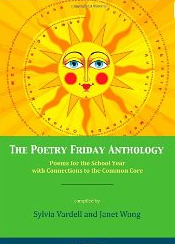
The Poetry Friday Anthology

If you are looking for age appropriate poetry to share with your students, check out this new anthology ed. by Sylvia Vardell and Janet Wong.  It contains one poem a week for 39 weeks for each grade level, K-5.  Poems the kids can relate to, current, challenging, and engaging.  Poems for sharing and to provoke conversation about themes and language. 


The poets in this book are: Joy Acey, Arnold Adoff, Jaime Adoff, Kathi Appelt, Jeannine Atkins, Brod Bagert, Carmen T. Bernier-Grand, Robyn Hood Black, Susan Taylor Brown, Joseph Bruchac, Jen Bryant, Leslie Bulion, Stephanie Calmenson, Deborah Chandra, Cynthia Cotten, Kristy Dempsey, Graham Denton, Rebecca Kai Dotlich, Margarita Engle, Betsy Franco, Carole Gerber, Charles Ghigna, Joan Bransfield Graham, John Grandits, Nikki Grimes, Lorie Ann Grover, Monica Gunning, Mary Lee Hahn, Avis Harley, David L. Harrison, Terry Webb Harshman, Juanita Havill, Georgia Heard, Esther Hershenhorn, Sara Holbrook, Carol-Ann Hoyte, Patricia Hubbell, Jacqueline Jules, Bobbi Katz , X. J. Kennedy, Michele Krueger, Julie Larios, Irene Latham, JonArno Lawson, Gail Carson Levine, Constance Levy, Debbie Levy, J. Patrick Lewis, George Ella Lyon, Guadalupe Garcia McCall, Heidi Mordhorst, Kenn Nesbitt, Lesléa Newman, Linda Sue Park, Ann Whitford Paul, Gregory Pincus, Jack Prelutsky, Mary Quattlebaum, Heidi Bee Roemer, Michael J. Rosen, Deborah Ruddell, Laura Purdie Salas, Michael Salinger, Ken Slesarik, Eileen Spinelli, Susan Marie Swanson, Amy Ludwig VanDerwater, Lee Wardlaw, Charles Waters, April Halprin Wayland, Carole Boston Weatherford, Steven Withrow, Allan Wolf, Janet Wong, and Jane Yolen.

The book is available from Amazon for $29.99 in paperback, $9.99 in Kindle, and $3.99 if you just want to buy one grade level.  But I wouldn't recommend that as teachers may want to browse other grade levels to find poems that fit with their classroom units. 

Sharing poetry is a fabulous way to get kids thinking, reading, and writing.  This anthology is fresh and fun, a good place to start for students and teachers who are looking for words and ideas to share.

Thursday, August 23, 2012

William Blake Enters the Fourth Grade


Oh, hark!  I hear the conversation leading up to the inclusion of William Blake in the Common Core State Standards (CCSS) Appendix of recommended literature for fourth grade.

Here’s a poem about a park.  Fourth graders like to play in the park.

Not in my neighborhood, they mostly play video games.

But it would be better if they played in the park, so let’s go with it.

Who’s the author?

William Blake.  I’ve heard of him.

THE William Blake of the 18th century?  The nutter who espoused free love and eschewed the church?  That William Blake?

Yes, that’s the best part.  He's out of copyright. 

Didn’t he have hallucinations about talking to angels in trees and God sticking his head in his bedroom window?

Look! He made a bunch of pictures to go with his poems.  A model for students illustrating their own poems.

Luckily most of his artwork will be blocked by elementary school search engines.

We don’t have to look at his artwork, we can just talk about it.  And look here, 12,462 PhDs have written their theses on him.  This guy is a great topic for online research assignments.

Most of those papers were written about whether or not opium influenced his writing and artwork.

A cross-curricular connection for science class! 

He thought marriage was institutionalized prostitution.

That works right into our social studies unit on slavery.  Do you see any math connections here?  We might have a home run.

Look, I just don’t think this guy is very good.  Most of his rhymes are too predictable and these couplets don't work at all:

The skylark and thrush,
The birds of the bush,

or

Till the little ones, weary,
No more can be merry:


He’s quirky, I’ll grant you that.

He was insane.

Since 1820 every educated person has had to study Blake. 

Not in fourth grade alongside Ramona and The Hardy Boys.  Even his contemporaries thought he was a mediocre poet and a headcase.

That was before he was dead, what did they know?  Stop trying to buck the system.  How else will we prepare them for seventh grade where he appears again rhyming “eye” with “symmetry?” 

Can’t we find a poem more relevant to kids’ lives rather than this thing written through the eyes of two bitter geezers leering at kids in a park discussing their youth-time?

He was a free thinker, he didn’t bow to the wishes of others.

Are you saying we should include him just because he is like the honey badger?  What about poetic form?  About relevancy of content?  About his themes?

The man was English, he is old, and he is out of copyright.  What more do you want?

A picture  of a fourth grader, included here for reference purposes. 
Below, a copy of Blake'spoem, included anywhere in the elementary curriculum for purposes I cannot discern.
 
Blake, William. “The Echoing Green.”
 
The sun does arise,
And make happy the skies;
The merry bells ring
To welcome the Spring;
The skylark and thrush,
The birds of the bush,
Sing louder around
To the bells’ cheerful sound;
While our sports shall be seen
On the echoing green.
Old John, with white hair,
Does laugh away care,
Sitting under the oak,
Among the old folk.
They laugh at our play,
And soon they all say,
‘Such, such were the joys
When we all—girls and boys—
In our youth-time were seen
On the echoing green.’
Till the little ones, weary,
No more can be merry:
The sun does descend,
And our sports have an end.
Round the laps of their mothers
Many sisters and brothers,
Like birds in their nest,
Are ready for rest,
And sport no more seen
On the darkening green.


Tuesday, August 07, 2012

Violence Hurts: A Discussion Starter

The past three months we have all witnessed the horrible reports of the shooting at nearby Chardon High School, the shooting at the theater in Denver, and the shooting at the Sikh Temple in Wisconsin.  Young Travon Martin was just walking home with an iced tea when he was shot.  Innumerable other cases wind through the courts and across our TV screens daily.  Add to these the various wars and uprisings and the movie heroes that shoot first and ask (or not) questions later and one almost begins to think that violence is the only way to settle disputes. Not only is it not the only way, it isn't even close to being the best option, but it sure gets all the press.

The poem I am posting here is from one of my older books.  I am hoping that teachers might use this as a possible discussion starter/writing prompt, perhaps even an impetus for on-line research. 

There was lots of discussion around the house this morning about whether the police radio is too distracting in the background.  At least the wee video has Michael and me talking about it! 

If any students do write a poem or reflection in response, I hope some will share.


Thursday, August 02, 2012

A back to school poem

Here is a back to school poem for all my teacher/principal/student friends.  Or anyone who ever remembers being a student and who maybe, like me, thinks January 1st is somewhat anti-climatic.  The real new year begins in the fall. 

Poem is from my book Zombies!  Evacuate the School!  delightfully illustrated by Karen Sandstrom.


Tuesday, July 24, 2012

Found Poem

Shifting power in the middle
upheaval
volume of the crowd’s voice
is increasing
the seismic movement,
changing
destruction of autocracy
power to the people
potential of hope.

In a techno-cleaning frenzy, I set out to delete or put in folders all the widowed links on my laptop's desktop.  That's the part that shows when I switch on a projector in front of an unwitting audience. Like a front stoop, I wanted to sweep and tidy up a bit before opening the door to strangers.  After a busy spring, including three trips to overseas schools, it was a cluttered mess.

I would be relentless.  I would be thorough.  I promised not to save one KB that couldn't be filed in an accessible place. No duplicates.  No mercy.  I started hitting the delete button with the fury and satisfaction of a whack-a-mole ace. 

The poem above was one of the saved documents, titled inauspiciously, Version 1.  I had already deleted 4 or 5 other Version 1s (different poems).  Version 1 means that I was writing this poem with a group of students or teachers and telegraphing to them that this wouldn't be the end of this writing process.  There would be other versions to come; we didn't have to get it right the first time. 

And while I couldn't claim authorship of this wee poem, I couldn't seem to hit delete either.  It was pretty good.  Was it about teacher protests in Wisconsin?  I was there last winter.  Was it about Occupy Wall Street?  I was on the East Coast.  It took me a day of hard thinking to remember -- it was written by a group of high school students at the Western Academy of Beijing.  It was International Day and the text we used to mine the words for our poem was a Time Magazine article about the Arab Spring.

I have always (secretly) thought the term "found poem" to be kind of amusing.  What other types are there, really?  Aren't they all?  Lost poems are the ones written on the backs of envelopes and then left on the bus or that voracious pocket on the seat in front of me on an airplane.  Lost poems are always the best pieces of writing to ever to walk across the page and out of our lives. 

But this, I can honestly say, is indeed a "found poem."  Found and then found again.  Lucky me.

Sunday, March 11, 2012

Bursts of Color


How does Cleveland, OH compare with Dhaka, Bangladesh?  Well, we were only gone a week on this trip, but we came home to bursts of color pushing up through last winter's grey in the front garden. 

And while Dhaka doesn't have much of a winter at least in Northern Ohio terms, they do have loads of grey.  Dust muting the greenery, grey rubble of construction (or demolition, hard to say) and heavy pollution.  But what I will remember of Dhaka will be the bursts of color.


Even women working in construction (or destruction, hard to tell) take care to wear brilliant fabrics.  This is an image to keep in mind the next time anyone feels they have a hard job.


Every rickshaw is a work of art. 


No matter where you are going in Dhaka, it seems as if you are going against traffic.  It's not so much a matter of going against the flow, but rather that the flow flows in all directions, with no traffic laws to speak of.  That is, when the traffic is moving, which it often is not.  Dhaka redefines gridlock like no other city on the planet.


Even at the International School Dhaka, you might be fooled by the grey and white uniforms.  But look closely and voila!


The brilliance comes shining through.

Happy faces, bright smiles, and welcoming hearts greeted us at ISD.  Many thanks to librarian Linda Lechasseur, Director Richard Tangye, the faculty, and the ever helpful staff. The entire ISD family was ready and eager to talk poetry.  We laughed while we worked writing poems about life and lessons.  Thank you to all of our new friends.

Monday, January 30, 2012

My School, My Toilet

When my mother was a kid, she used to proudly announce whenever her parents drove past her elementary school: "That's my school, my toilet."  This statement makes more sense if you remember that she went to a small school in then rural Zanesville, OH, with an outhouse.  Perpetuated as family stories are through telling and re-telling, when I was growing up we never referred to my school with out mentioning the toilet, even though mine came with indoor plumbing and individual stalls. 

I tried it a couple of times with my kids and they gave me those narrow-eyed stares that meant the story was just not working for them and toilet talk from Mom wasn't as nostalgically amusing as I thought it to be.

Life moves on.  My old elementary school, its worn marble staircase and toilets with wooden doors, is now a parking lot for the high school.  Today, when I think of my home school (my toilet), I think of Westerly Elementary in Bay Village, OH.  That's where my oldest daughter Katie started kindergarten (before it became an intermediate school), where Kelly attended and it is the home of a whole stack of poems, from my long ago encounter with Mrs. Woodburn that lead to The Dog Ate My Homework, to the list poem about a school in my book Zombies!   

So, a visit to Westerly is always like going home.  Thanks to the efforts of Martha Fisher, we had a spectacular visit the first week in January.  I was even able to give Mrs. Woodburn a hug.  Even though smart boards have replaced green boards, nothing has managed to replace the students love of poetry.  Hooray!

And yes, the toilets work just fine.


Saturday, January 14, 2012

Antiques Made to Order


In a world where 65 year olds have no wrinkles, where Photoshop magically gives adult women the 18 inch waist Scarlett O’Hara dreamed of, and spell check makes us all appear more clever than we really are, you would think I would be used to the idea that nothing is as it appears.

Still it’s a bit of a shock to see signs in store windows here in Bali announcing, ANTIQUES MADE TO ORDER.

Reminder, trust nothing unless you buy directly from the craftsperson (or in the case of antiques, someone who attended the McKinley inauguration. 


So I bought this bag in Beijing from a woman dressed in traditional Tibetan garb, the hat, the draping, the skin darkened by years without sunscreen.  The only one of its kind in her booth.  A ratty looking booth in an open-air market.  Price, about $20 USD after a respectable negotiation, good for her, good for me.  Not a designer bag, but designed by someone and good looking.  Hand stitched.  Deep enough to carry my tech stuff.  Not exactly directly from the craftsperson, but not too many people in the food chain making money off of the crafts people.  Good deal.

I get to Bali and my friends Larry and Rai Collins take a look at the bag and say, nice bag, we bought some for friends in Thailand last year.

Not Tibet?  I ask?

No.  Thailand.  $6.

Okay.  $6 - $20, not too bad of a mark up.  Who knows how much the ladies got for all that hand stitching.  More people in the food chain than I would have liked.

So, yesterday we are in a juice bar having seriously healthy carrot/apple/ginger juice and what do we see hanging for sale?  One of kind?  Hand stitching and all?

Same bag.

$150 USD.

True story. 

Or is it?

Monday, January 02, 2012

Happy New You, 2012


Michael took this picture (okay, I begged and whined a little asking for this angle and that) in the botanical gardens in Singapore.  I was limping along and this sculpture embodied who I wanted to be.

So, this is my screen saver and pictorial inspiration for 2012. 

2012.  Riding into the second decade of this new century. 

Wheeeeeeeee!