Showing posts with label poets. Show all posts

Thursday, January 29, 2015

Backwards Day All Year Long


Dan Ferri

Some poems visit you at sunset. Some haunt you in the wee hours with Jabberwocky logic because, let's face it, anything seems logical at 3AM.  There are poems you reach for when a friend dies, when a marriage implodes, when gratitude washes away pain.

Dan Ferri's poem, Backwards Day, follows me down school hallways behind 7th graders hiding their faces in hoodies. It stands with me as I watch the kid who can't hold a pencil and whose school won't let him use a keyboard try to make a joke out of it. It sits on my knee in a kindergarten class while everyone else is sitting on the carpet.  This poem is for those who would rather cartwheel than walk, draw instead of formulate equations, those who write, know how to harmonize, and problem solve.

Holidays, snow days, and low grade fevers should never happen on the weekend.  This Saturday is Backwards day, and because of that, I was afraid it would be overlooked this year.  

You know what this list is?  It's a list of what proficiency tests do NOT measure.  I found it in a book by Gerald Bracey, On the Death of Childhood and the Destruction of Public Schools (Heinemann 2003, in case you are looking for some light reading).  

As we head into testing season (I know this because of schools that call asking for a visit "after the tests") I'm thinking maybe Backwards Day shouldn't be only an annual event like the 100th day of school or Dr. Seuss' birthday, but a holiday that we celebrate all year long.

Dan is a seasoned middle school teacher transplanted from Chicago to Canberra, Australia, and as such he knows schools, holidays, and isn't afraid to call out puppypoop when he sees it.  Reprinted here with permission. 

Backwards Day

Sometimes at school we have a special day
We call it backwards day
Everyone wears their clothes backwards
Or wears colors that clash
I have a modest proposal
Forget your silly backwards hats and tee shirts
Forget this stripes and checks together puppypoop
Let's get serious
Let's really shake school up

In math class, for homework
Describe the associative, distributive, and
Commutative properties
In dance
Choreograph it, dance it, show your work
Points off for clumsiness

In Social Studies, for homework
Prepare two Civil War marching songs, one North one South
Sing in four-part harmony, show your emotion
Points off for flat notes

In English, for homework
Carve a sculpture that expresses Hester Prynne's solitary courage
The cowardice of her lover
The beauty and strangeness of her child

In Science, for homework,
Bring in a broken toaster, doorknob, or wind-up toy
Fix it
You get extra credit for using the leftover parts to make something new
Points off for reading the directions

On the S.A.T.
Every one of the questions
Will be in haiku

You get two scores
One in whistling, and one in Legos
No calculators

Let's take a stroll down the hall
Let's see who is in the learning disabilities classroom now
Will you look at all those guys with pocket protectors
Sweating, slouching, and acting out
  
Hey, no one cares that you can divide fractions backwards in
your head buddy
You will stay right here and practice interpretive dance steps till
you get it right

Will you look at all those perfect spellers with bad attitudes
Look at those grammar wizards with rhythm deficit disorder
What good is spelling gonna do you
If you can't carry a tune
Toss a lariat
Or juggle?

You are going to stay right here and do the things that you can't
Over and over, and again, and again
Until you get them right,
Or until you give up
Quit school
And get a job
As a spell checker
At the A&P

~Daniel Ferri


Monday, August 11, 2014

Fear, Courage, and Poetry

Janet Wong and Sylvia Vardell, the creators of The Poetry Friday Anthology for Middle School, have designed the coolest image to go with my poem Fear Factor.  It is just the right resource for sharing poetry throughout the year.

They have also given me permission to share the Take 5 lesson they have designed to go with the poem.  If you are interested in another example of an apostrophe poem, a poem in which the poet talks to someone or something, read below.  The Prisoner In Aghmat Speaks To His Chains is a poem that I selected to model this style of writing in my book, Practical Poetry.

Imagine the lesson extensions on this one!  But don't just imagine, put it to good use!


King Al-Mu'tamid, 'The Prisoner In Aghmat Speaks To His Chains'

The Prisoner In Aghmat Speaks To His Chains

I said to my chains,
don't you understand?
I have surrendered to you.
Why, then, have you no pity,
no tenderness?

You drank my blood.
You ate my flesh.
Don't crush my bones.

My son Abu Hasim sees me
fettered by you and turns away
his heart made sore.

Have pity on an innocent boy
who never knew fear
and must now come begging to you.

Have pity on his sisters
innocent like him
who have had to swallow poison
and eat bitter fruit.

Some of them are old enough
to understand and I fear
they will go blind from weeping.

The others are now too young
to take it in and open their mouths
only to nurse.


by King Al-Mu'tamid of Sevilla
Translated by Cola Franzen
from the Spanish version of the Arabic by Emilio García Gómez


Al-Mu'tamid, the "Poet-King" of Sevilla, reigned from 1068 to 1092. He was dethroned and then exiled to Aghmat (Morocco) by the Berber Almoravids whom he himself had invited to Spain to help the Moorish rulers fight Alfonso VI. He died in captivity in Aghmat in 1095. With his exile the great age of Islamic culture began to decline in Spain.
-- Cola Franzen, "Poems of Arab Andalusia", 1989

Sunday, September 01, 2013

Emily, Julie and me.

It was a winter day in the late seventies.  I had been struggling with the joyless parts of stay at home mothering and not particularly well.  I wasn’t fitting in with my new neighbors, the junior women's club, or the corporate wives’ club.  I didn’t play bridge that well and I never could manage to get my hair dry before the guests arrived.  Any passing attraction I might have had to matching finger towels was always counterbalanced by my ability to grow dust bunnies the size of raccoons while reading or daydreaming. I was having trouble finding my place in the world.

That afternoon, I put both kids to bed for a nap and sat down to watch a much anticipated re-airing of Julie Harris in the Belle of Amherst on public television.  No “on demand” in those days.  I had to scramble like a dog on linoleum to get everything in order for the 1:00 viewing on our 22 inch black and white television.  I rolled the metal cart over by the fireplace, adjusted the rabbit ears, lit a fire and sat.  Probably munching on a bologna sandwich on white bread.  It was a long time ago.

But not so long that I have forgotten a moment of her performance. Julie welcomed the audience with black cake and dry humor.  The cake recipe called for 19 eggs and somehow she made that a laugh line.  I cried with her when her beloved nephew died (by that point in the play Harris WAS Emily), rooted for her birds as she shew-shewed her sister Lavinia’s cats away, and cheered as she stood up to the status quo.  Her neighbors thought she was strange, and instead of compliance with their standards, she just returned the sentiment, brushing them off as housewives do a fly. Who can't admire that kind of starch in her white frock?

Emily wrote with no audience to speak of.  Pre-internet, pre-self-publishing (so public, like a frog), she wrote and studied words and put them in a box.  Having already experienced rejection from Highlights Magazine, I identified with her rejections.  With those who called her rhymes irregular, rhymes which she herself dubbed “experimental.”  I had recently been told that my poems “exacerbate the insecurities of youth, dwelling on self-interest at the expense of others,” which I thought sounded like something I could do hard time for.  We were simpatico, Emily and I.  Ironically it would be that very magazine’s book publishing arm, Boyds Mills Press, that did publish my first book 19 years later, but at that point in my life, facing rejections, dust bunnies, and a never ending river of diapers, I had (frankly) come a little undone around the edges. 

Following this performance, I went downtown Cleveland and bought a properly leather-bound journal at Publix Bookstore.  Then I scrubbed out an antique wooden tool chest.  I read more poetry.  I copied poems onto index cards and tacked them up around the kitchen sink to memorize when my hands were wet and my brain was wandering. I studied the rhythm of language.  And my frazzled parts began to re-fuse. To this day, if I begin to fray, I know it is because I have not written for a while.  Not writing to sell, just writing to focus on what is real.

Subsequently, I would fill that tool box, floppy disks, CDs, hard drives, and now my space in the cloud. For all those 19 years, I would write, share with friends, and put the poems in the box. Harris-as-Emily had convinced me this was an acceptable pursuit. I developed my craft.  And because I wrote apart from the market place, I never sat down to write a single book containing 30 poems on dinosaurs or as a Scholastic editor once urged me, (gasp) on vampires. I have the meager monetary returns to prove it. I simply wrote what I saw and what I wondered about.

When Harris took her bow that afternoon, I applauded.  Right there in the living room.  Bounced up and down on the green flowered love seat clapping like a mad woman.  All by myself.  I applauded the performance and Emily’s spirit of rebellion, her ambivalence for organized religion, and her fierce love of family and words.  As a stellar performance should, Harris-as-Emily not only invited me in, but deposited a part of herself in my heart. I saw her later live at the Hanna Theater and the LP recording of her live performance as The Belle of Amherst is the only vinyl I have kept.  But that afternoon, just us in the living room, remains a sparkling blue sapphire in my frequently overdrawn memory bank.


For what she gave to the world in terms of dignity and skill and for the riveting thrill she gave me that afternoon, thank you Ms. Harris.  

And please don’t rest in peace.  
Stay feisty. 


 Julie Harris
1925-2013

Saturday, November 10, 2012

Hate Was Not his Normal State


War is the Fiercest Art

The Luc Bat poet knew
His country broke in two, therefore
He had to go to war.
His wife and child, heartsore, waved bye.
The poet dared not cry.
He needed a clear eye to spill
Blood, strangers he must kill
To stay alive until the time
He could again in rhyme
Make images sublime. His heart
Was wracked and torn apart.
War is the fiercest art. Trading
Pen for gun, evading Death,
Armies invading. This hate
Was not his normal state.
One question would frustrate, for he
Knew not this enemy.
Might you love poetry?
     I, too.
sara holbrook
ed. Lee Bennett Hopkins

When Lee sent out the invitation to poets to write poems to chronicle each of the wars that America has engaged in over its lifetime, I remembered a story I had seen on 60 Minutes (as I recall).  It told the story of an American soldier who found a book of poetry on a dead Vietnamese soldier, poetry that he himself was writing during the prolonged tragedy that we call the Vietnam War and that the Vietnamese call the American War.

In the story, the American soldier traveled back to Vietnam 30 years later to return the book of poetry and a photograph to the Vietnamese soldier's family.  I can't find a link on line, but I remember wondering as I watched the narrative: what would that be like?  A poet called to war?  In the US, some men and women served, but most did not.  There were no such choices to be made for the Vietnamese as the war exploded all around them. The image of a poet does not come to mind when we think of Rambo.

So, doing my best to follow the Vietnamese poetry form, I wrote a Luc Bat from that imaginary (to me) soldier's perspective, which now appears in Lee's book, America At War.  Luc Bat (to my understanding) means six eight, alternating lines of six syllables, eight syllables, with each rhyme repeated three times, interwoven and snaking down the page to whatever length the poet chooses, rhyming the last line with the first.

Last weekend Michael Salinger, Nancy Johnson and I were having a quiet dinner in Ho Chi Minh City when our young waiter whispered that the man sitting at a table in the back of the restaurant was a famous poet.  The young waiter,  Ngô Tiêů Lân, had studied him in school.  He explained that the poet, Nguyên Quang Sáng  had traveled to the US to read his poetry.  The 23-your-old spoke with great reverence.  When we told Ngô Tiêů Lân that we too were poets, introductions were made.  Pictures taken.  Friendly nods and smiles exchanged while Ngô Tiêů Lân busily translated.

After we went back to our table, Mr. Sang slowly came over to our table.  He wanted to talk about how the US and Vietnam were friends now.  We need to come together, he said.  Move forward together, he said, bringing his fingertips together in a tent.  He does not like to think about the war, in fact he comes to this restaurant on Saturday night to drink whiskey and forget about the war.


Mr. Sang is the winner of the Ho Chi Minh award that is only given every twelve years.  He is the author of not only poetry, but children's books, plays and movie scripts.  Not only did our young waiter know the significance of his contribution to Vietnamese literature, the desk clerks at our hotel were astonished that we had met him in person.  Where?  Where?  They wanted to know.

He is a poet who was a soldier because the times demanded it.

We paid for his whiskey.

Tuesday, September 04, 2012

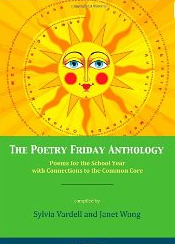
The Poetry Friday Anthology

If you are looking for age appropriate poetry to share with your students, check out this new anthology ed. by Sylvia Vardell and Janet Wong.  It contains one poem a week for 39 weeks for each grade level, K-5.  Poems the kids can relate to, current, challenging, and engaging.  Poems for sharing and to provoke conversation about themes and language. 


The poets in this book are: Joy Acey, Arnold Adoff, Jaime Adoff, Kathi Appelt, Jeannine Atkins, Brod Bagert, Carmen T. Bernier-Grand, Robyn Hood Black, Susan Taylor Brown, Joseph Bruchac, Jen Bryant, Leslie Bulion, Stephanie Calmenson, Deborah Chandra, Cynthia Cotten, Kristy Dempsey, Graham Denton, Rebecca Kai Dotlich, Margarita Engle, Betsy Franco, Carole Gerber, Charles Ghigna, Joan Bransfield Graham, John Grandits, Nikki Grimes, Lorie Ann Grover, Monica Gunning, Mary Lee Hahn, Avis Harley, David L. Harrison, Terry Webb Harshman, Juanita Havill, Georgia Heard, Esther Hershenhorn, Sara Holbrook, Carol-Ann Hoyte, Patricia Hubbell, Jacqueline Jules, Bobbi Katz , X. J. Kennedy, Michele Krueger, Julie Larios, Irene Latham, JonArno Lawson, Gail Carson Levine, Constance Levy, Debbie Levy, J. Patrick Lewis, George Ella Lyon, Guadalupe Garcia McCall, Heidi Mordhorst, Kenn Nesbitt, Lesléa Newman, Linda Sue Park, Ann Whitford Paul, Gregory Pincus, Jack Prelutsky, Mary Quattlebaum, Heidi Bee Roemer, Michael J. Rosen, Deborah Ruddell, Laura Purdie Salas, Michael Salinger, Ken Slesarik, Eileen Spinelli, Susan Marie Swanson, Amy Ludwig VanDerwater, Lee Wardlaw, Charles Waters, April Halprin Wayland, Carole Boston Weatherford, Steven Withrow, Allan Wolf, Janet Wong, and Jane Yolen.

The book is available from Amazon for $29.99 in paperback, $9.99 in Kindle, and $3.99 if you just want to buy one grade level.  But I wouldn't recommend that as teachers may want to browse other grade levels to find poems that fit with their classroom units. 

Sharing poetry is a fabulous way to get kids thinking, reading, and writing.  This anthology is fresh and fun, a good place to start for students and teachers who are looking for words and ideas to share.

Thursday, August 23, 2012

William Blake Enters the Fourth Grade


Oh, hark!  I hear the conversation leading up to the inclusion of William Blake in the Common Core State Standards (CCSS) Appendix of recommended literature for fourth grade.

Here’s a poem about a park.  Fourth graders like to play in the park.

Not in my neighborhood, they mostly play video games.

But it would be better if they played in the park, so let’s go with it.

Who’s the author?

William Blake.  I’ve heard of him.

THE William Blake of the 18th century?  The nutter who espoused free love and eschewed the church?  That William Blake?

Yes, that’s the best part.  He's out of copyright. 

Didn’t he have hallucinations about talking to angels in trees and God sticking his head in his bedroom window?

Look! He made a bunch of pictures to go with his poems.  A model for students illustrating their own poems.

Luckily most of his artwork will be blocked by elementary school search engines.

We don’t have to look at his artwork, we can just talk about it.  And look here, 12,462 PhDs have written their theses on him.  This guy is a great topic for online research assignments.

Most of those papers were written about whether or not opium influenced his writing and artwork.

A cross-curricular connection for science class! 

He thought marriage was institutionalized prostitution.

That works right into our social studies unit on slavery.  Do you see any math connections here?  We might have a home run.

Look, I just don’t think this guy is very good.  Most of his rhymes are too predictable and these couplets don't work at all:

The skylark and thrush,
The birds of the bush,

or

Till the little ones, weary,
No more can be merry:


He’s quirky, I’ll grant you that.

He was insane.

Since 1820 every educated person has had to study Blake. 

Not in fourth grade alongside Ramona and The Hardy Boys.  Even his contemporaries thought he was a mediocre poet and a headcase.

That was before he was dead, what did they know?  Stop trying to buck the system.  How else will we prepare them for seventh grade where he appears again rhyming “eye” with “symmetry?” 

Can’t we find a poem more relevant to kids’ lives rather than this thing written through the eyes of two bitter geezers leering at kids in a park discussing their youth-time?

He was a free thinker, he didn’t bow to the wishes of others.

Are you saying we should include him just because he is like the honey badger?  What about poetic form?  About relevancy of content?  About his themes?

The man was English, he is old, and he is out of copyright.  What more do you want?

A picture  of a fourth grader, included here for reference purposes. 
Below, a copy of Blake'spoem, included anywhere in the elementary curriculum for purposes I cannot discern.
 
Blake, William. “The Echoing Green.”
 
The sun does arise,
And make happy the skies;
The merry bells ring
To welcome the Spring;
The skylark and thrush,
The birds of the bush,
Sing louder around
To the bells’ cheerful sound;
While our sports shall be seen
On the echoing green.
Old John, with white hair,
Does laugh away care,
Sitting under the oak,
Among the old folk.
They laugh at our play,
And soon they all say,
‘Such, such were the joys
When we all—girls and boys—
In our youth-time were seen
On the echoing green.’
Till the little ones, weary,
No more can be merry:
The sun does descend,
And our sports have an end.
Round the laps of their mothers
Many sisters and brothers,
Like birds in their nest,
Are ready for rest,
And sport no more seen
On the darkening green.