I’ve seen the Discovery specials on salmon, how they leap dramatically up waterfalls to get upstream. What they don’t show you on TV is the bonepiles of salmon that don’t make it. How they fall into piles of decay and become sushi for their canabalistic fellow travelers.
Catching salmon is about timing the tides and the runs against the fisherman’s patience and vacation time. For the salmon, timing their run into the spawning stream at high tide seems to be key in Whittier, Alaska. Time it wrong and the big ones die in shallow tide pools.
Timing, as it has always been, is life or death.
Whittier is a place out of time. The only route into town is a still functioning railroad tunnel that also functions as the longest tunnel for cars in the U.S., 2.5 miles. You might think that means the train runs beside the cars, but no. The trains and the cars take turns in a single lane tunnel, the cars rolling straight down the train tracks. The tunnel itself is more like a cave with gray, seeping bolder walls. A tall, thin tunnel, it leads to a little outpost on Prince Edward Sound. Michael fished most of today and I went back to Tucson with Hannah, thanks to a laptop and an electrical outlet in the rental car.
It was a brilliant day.

Sunday, August 28, 2005


Saturday, August 27, 2005
and when you turn off the paved road
I once received directions to a school in southern Ohio that read: Take the interstate to the state route, turn onto the county road, when you get into town turn right at the stop sign. No matter what the street name, there’s only one stop sign. The last sentence began, and when you turn off the paved road . . . I actually thought myself rather adventurous taking off for that school years ago.
Today we followed similar directions to Lisa and Rick Sinnott’s cabin above Ekluka Lake, northeast of Anchorage. Rick and Lisa are friends from a previous visit – Lisa is a librarian at Wendell Middle School and Rick is the moose man of Anchorage, a biologist and wildlife specialist. They have a regular house in Anchorage with running water and a necessary room – not so in their cabin in the woods where the necessary room is 30 paces from the cabin.
After 5 straight days of rain, the sun has reintroduced itself to the sky. When we arrive at Ekluka Lake, steam is rising off of the glacier lake into the cool morning. Just as the phrase “lone wolf” is a misnomer since they actually are pack animals, the term “clear glacier lake” is also untrue. A glacier lake is in fact cloudy with silt and not full of fish like the soft drink commercials would have you believe, the water is too dark for them. So there. A quick look and then on to the cabin.
We drive part way up to the Sinnott’s cabin (way off the paved road) to where Lisa has placed a wagon across the road warning us of an impassable trail, so we park the rental car (Avis would be so happy) and trek the rest of the way around and through deep mud ruts. EVERYTHING in Alaska is vast, even its road ruts which could easily swallow feet, shoes, tires and probably small children under the age of 12. Rick is off hunting wild sheep and Lisa and Megan are at the cabin to greet us. We have some lunch, tour the one room cabin and the site of their home to be. The cabin itself is modeled after a potting shed, very Thoreauvian, all built as Lisa says, “the hard way,” by hand, even the beds and cabinets. The closet is railroad ties pounded into the wall and in the corner a small cookstove. An ideal retreat complete with stacked wood and bear stories.
Meg, Michael, Lisa and I proceed to the lake with two kayaks. Michael and Lisa hike three miles to meet Megan and I who kayaking across the lake with the wind to our backs. Then we switch with Megan and I hiking back and M and L paddling against the current of the lake. Peeking between the saddle of two mountains is a glacier in retreat. Brilliant green trees meet luminous blue water. It is a stunning hike.
After 3 hours on the lake we go back to the cabin where Rick has returned. On the other side of the mountain the hunters have harvested one female sheep. Licenses for sheep hunting are done by lottery up here. After felling the sheep, Rick and his friend Steve had to cut it in half and carry it back down the mountain on their backs. This gives new definition to the phrase “hand to mouth,” seeing the thing in pieces in a box.
As the light begins to dwindle in the cabin, we share stories beside a cast iron stove. I’m thinking in the “writer’s” section at Borders they should sell these stoves. What book on writing prompts can be half as effective as a little quiet time, no television and a crackling stove for drawing stories out of folks?
Today we followed similar directions to Lisa and Rick Sinnott’s cabin above Ekluka Lake, northeast of Anchorage. Rick and Lisa are friends from a previous visit – Lisa is a librarian at Wendell Middle School and Rick is the moose man of Anchorage, a biologist and wildlife specialist. They have a regular house in Anchorage with running water and a necessary room – not so in their cabin in the woods where the necessary room is 30 paces from the cabin.
After 5 straight days of rain, the sun has reintroduced itself to the sky. When we arrive at Ekluka Lake, steam is rising off of the glacier lake into the cool morning. Just as the phrase “lone wolf” is a misnomer since they actually are pack animals, the term “clear glacier lake” is also untrue. A glacier lake is in fact cloudy with silt and not full of fish like the soft drink commercials would have you believe, the water is too dark for them. So there. A quick look and then on to the cabin.
We drive part way up to the Sinnott’s cabin (way off the paved road) to where Lisa has placed a wagon across the road warning us of an impassable trail, so we park the rental car (Avis would be so happy) and trek the rest of the way around and through deep mud ruts. EVERYTHING in Alaska is vast, even its road ruts which could easily swallow feet, shoes, tires and probably small children under the age of 12. Rick is off hunting wild sheep and Lisa and Megan are at the cabin to greet us. We have some lunch, tour the one room cabin and the site of their home to be. The cabin itself is modeled after a potting shed, very Thoreauvian, all built as Lisa says, “the hard way,” by hand, even the beds and cabinets. The closet is railroad ties pounded into the wall and in the corner a small cookstove. An ideal retreat complete with stacked wood and bear stories.
Meg, Michael, Lisa and I proceed to the lake with two kayaks. Michael and Lisa hike three miles to meet Megan and I who kayaking across the lake with the wind to our backs. Then we switch with Megan and I hiking back and M and L paddling against the current of the lake. Peeking between the saddle of two mountains is a glacier in retreat. Brilliant green trees meet luminous blue water. It is a stunning hike.
After 3 hours on the lake we go back to the cabin where Rick has returned. On the other side of the mountain the hunters have harvested one female sheep. Licenses for sheep hunting are done by lottery up here. After felling the sheep, Rick and his friend Steve had to cut it in half and carry it back down the mountain on their backs. This gives new definition to the phrase “hand to mouth,” seeing the thing in pieces in a box.
As the light begins to dwindle in the cabin, we share stories beside a cast iron stove. I’m thinking in the “writer’s” section at Borders they should sell these stoves. What book on writing prompts can be half as effective as a little quiet time, no television and a crackling stove for drawing stories out of folks?
Thursday, August 25, 2005
Thunderbird Falls
Thunderbird Falls
Friday we went out fishing. Let me clarify that. Michael fished at Ship Creek and I napped in the car. After a few hours there, we went exploring north east of Anchorage around the Eagle River. We hiked up to Thunderbird Falls.
Michael was disappointed to see a “no fishing until after Sept. 15" sign posted at the Eagle River. But we went down to explore anyway. Flopping and humping over rocks, we watched a king salmon seemingly crawl upstream across the rocky creek bed. It happened too fast to grab for the camera – a “did you see that!” few moments. Alaska is full of those – whales spitting through blow holes, eagles in flight, rainbows. Spectacular memories that come from flashes, moments to remember.
Gasp. I almost said precious moments, which of course is that line of cutesy little cherub statues. Nothing about Alaska seems cutesy. It is vast and spectacular. The mountains are dark and intense. The waterways, large and roiling.
Friday we went out fishing. Let me clarify that. Michael fished at Ship Creek and I napped in the car. After a few hours there, we went exploring north east of Anchorage around the Eagle River. We hiked up to Thunderbird Falls.
Michael was disappointed to see a “no fishing until after Sept. 15" sign posted at the Eagle River. But we went down to explore anyway. Flopping and humping over rocks, we watched a king salmon seemingly crawl upstream across the rocky creek bed. It happened too fast to grab for the camera – a “did you see that!” few moments. Alaska is full of those – whales spitting through blow holes, eagles in flight, rainbows. Spectacular memories that come from flashes, moments to remember.
Gasp. I almost said precious moments, which of course is that line of cutesy little cherub statues. Nothing about Alaska seems cutesy. It is vast and spectacular. The mountains are dark and intense. The waterways, large and roiling.
Anrchorage, Janet Allen Institutes Goodbye
And it ended with a poem
The Janet Allen Literacy Institutes, so much a part of my life for the last nine years, are now officially over. I have made life long colleagues and the skeleton staff that was here in Anchorage toasted the good learning times that we have had together. Anne wrote a narrative, detailed poem about our vagabond summers to end the last session. For me, that brings me full circle as my first invitation to an institute came as a result of one of my poems.
I suppose in a metaphorical sense, this is what I wish for my life – that one poem leads to another.
On Thursday, Michael will arrive and we have 5 days to explore. Meantime, I need to buy a jacket – the last week of August is fall in Anchorage, more like October in OH.
The Janet Allen Literacy Institutes, so much a part of my life for the last nine years, are now officially over. I have made life long colleagues and the skeleton staff that was here in Anchorage toasted the good learning times that we have had together. Anne wrote a narrative, detailed poem about our vagabond summers to end the last session. For me, that brings me full circle as my first invitation to an institute came as a result of one of my poems.
I suppose in a metaphorical sense, this is what I wish for my life – that one poem leads to another.
On Thursday, Michael will arrive and we have 5 days to explore. Meantime, I need to buy a jacket – the last week of August is fall in Anchorage, more like October in OH.
Friday, August 12, 2005
Friday, the last day. Debbi and I cruise some neighborhoods to look for Gran’s trailer park and the high school where Hector and Hannah go to school. We drive through some parks and decide they are a little too scrappy - Gran wouldn’t live there. Or there. Finally, we find the park. One end of it has spaces for the snowbirds, the other part is permanent housing. Each trailer has an over-hang side porch area and a small front yard, three feet deep and about 8 feet long. Gran and Sam are retired factory workers, a dying breed. This is a good place for them to live.
I spend a warm family evening with my aunt Sophie and Uncle Bill, cousins and cousins once removed. We have so much to be grateful for.
Now it is time to write.
I spend a warm family evening with my aunt Sophie and Uncle Bill, cousins and cousins once removed. We have so much to be grateful for.
Now it is time to write.
Thursday, August 11, 2005


Legalities
Today Hannah went to court to support two Samaritans who were recently arrested for assisting 3 immigrant travelers who they found in the desert suffering bloody stools and hallucinations – late stage dehydration. After consulting with a physician by phone, they were taking the travelers to the hospital and were stopped by border guards and arrested. The travelers, who were showing signs of recovery (often false bravado after a few sips of water) were released. There wasn’t enough room for us in the courtroom, but still it was good we showed up at the arraignment to show support for the Samaritans.
From there, Deb and Ed took Hannah into Mexico to see what real poverty looks like. We drive up and down steep streets, houses hanging onto the side with improbable tenacity. The wall separating the US from Mexico is made of sheets of rusted, corrugated steel with rolled razor wire across the top. Decorating the Mexican side are crosses commemorating souls lost in transit. The eager sales people try to engage with smiles and commonalities – where you from? I know that place. Come in. Come see. You never know.”
True. You never know. But Hannah and I certainly know more than we did a few days ago about the disparities in defining the word “poor.”
From there, Deb and Ed took Hannah into Mexico to see what real poverty looks like. We drive up and down steep streets, houses hanging onto the side with improbable tenacity. The wall separating the US from Mexico is made of sheets of rusted, corrugated steel with rolled razor wire across the top. Decorating the Mexican side are crosses commemorating souls lost in transit. The eager sales people try to engage with smiles and commonalities – where you from? I know that place. Come in. Come see. You never know.”
True. You never know. But Hannah and I certainly know more than we did a few days ago about the disparities in defining the word “poor.”
Wednesday, August 10, 2005
Hannah meets the desert
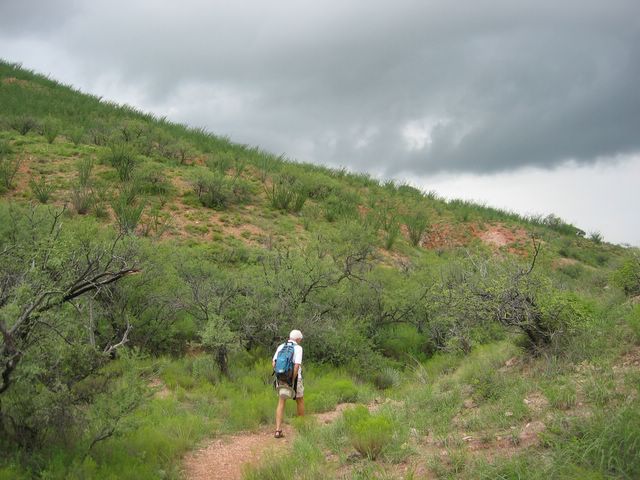
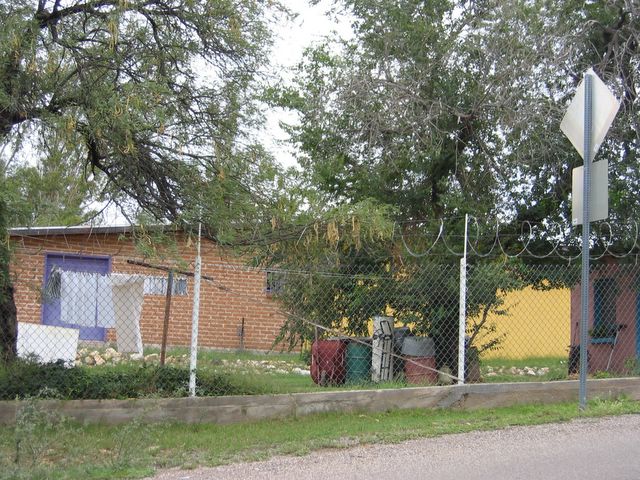
Hannah was shocked today. The desert was alive and green. August is monsoon season and the flowers, the thick clouds and the fire ants were all out in force. I know enough about the AZ desert to know that it is not just sand and camels – but I was not prepared for all the greenery, the thickets of mesquite trees.
First we went to the border. It isn’t much. A station, some wire, guards behind glass. But on all sides it is surrounded by the wide open spaces. From there we went to walk a trail that migrants take crossing el frontero. The path is rocky, uneven and prickly. Our hiking crew was led by Ed, followed by Debbi, me, and my 84 year old aunt Sophie and Uncle Bill.
I mention my aunt and uncle’s ages here because someone would have to tell you or you wouldn’t believe it. They celebrate every day with new learning and experiences and are my heros. Ed led us on a hike along a trail through a wild life preserve and pathway to the US from the border. The border guards are evident in broncos and hummers. They patrol on horses and leave ATV tracks skidding through the washes. I felt like a criminal just walking in a national park.
Every story has two sides, of course. The migrants come here looking for a better life, as migrants have moved for all of history. But today they leave behind mounds of plastic trash, old clothes and backpacks. The litter is overwhelming, dumped on public lands and the lands of ranchers who feel overwhelmed and threatened by the increased foot traffic.
From there we went to a No More Death outpost and met the friendly, dedicated crew manning the station where I collected images and stories. Their mission is to provide relief to migrants in crisis.
Lastly, we visited with two of Debbi’s artist colleagues who are working on a sculpture installation that is magnificent. No pictures of that as it has yet to be unveiled, but see the picture of some of the haunting, incredibly detailed dolls my Debbi made to honor those who have died in the desert.
I am too tired tonight to continue writing, but I have pages filled with notes. Hannah had a big day today.
First we went to the border. It isn’t much. A station, some wire, guards behind glass. But on all sides it is surrounded by the wide open spaces. From there we went to walk a trail that migrants take crossing el frontero. The path is rocky, uneven and prickly. Our hiking crew was led by Ed, followed by Debbi, me, and my 84 year old aunt Sophie and Uncle Bill.
I mention my aunt and uncle’s ages here because someone would have to tell you or you wouldn’t believe it. They celebrate every day with new learning and experiences and are my heros. Ed led us on a hike along a trail through a wild life preserve and pathway to the US from the border. The border guards are evident in broncos and hummers. They patrol on horses and leave ATV tracks skidding through the washes. I felt like a criminal just walking in a national park.
Every story has two sides, of course. The migrants come here looking for a better life, as migrants have moved for all of history. But today they leave behind mounds of plastic trash, old clothes and backpacks. The litter is overwhelming, dumped on public lands and the lands of ranchers who feel overwhelmed and threatened by the increased foot traffic.
From there we went to a No More Death outpost and met the friendly, dedicated crew manning the station where I collected images and stories. Their mission is to provide relief to migrants in crisis.
Lastly, we visited with two of Debbi’s artist colleagues who are working on a sculpture installation that is magnificent. No pictures of that as it has yet to be unveiled, but see the picture of some of the haunting, incredibly detailed dolls my Debbi made to honor those who have died in the desert.
I am too tired tonight to continue writing, but I have pages filled with notes. Hannah had a big day today.
Tuesday, August 09, 2005
Tucson
This trip seems somehow, weirdly, self-indulgent. I always feel guilty when leaving family at home. Always. The guilt will never go away or change – I have to just pack it with me and drag it along. An extra carry-on.
I am on this trip because I am researching a new novel.
That phrase seems so upbeat and confident on its own. If that sentence had legs, they would be rushing away at nobel or pulitzer clip. Ta Ta – must be off and all that. Could you give me a hand here, that’s it. Up and over. On the way, off we go.
Well, not with that kind of confident assurance, but I am. Researching a novel. In the novel, Hannah from Cleveland gets dropped off indefinitely with her gran in Tucson. There she gets way more involved with the local border issues than she could have foreseen.
So, in order to write the book, I am here in Tucson to take a lot of notes. Meeting me at the airport was Ed, my cousin Debbi’s husband. Guess he got the short straw. Already on the drive to their house, I am revising what I have written so far in consideration of his narrative. I need to be here, to indulge my imaginings.
Still, it IS a risky thing to declare oneself in the process of writing a novel. Isn’t it? And I can’t do this without help – now there is extra pressure, I must do well since others have invested precious time in my project. Part of me wants to bail quickly – but the cat is out. The first few chapters are out. This is it. I am researching. And according to Ray Bradbury – I should enjoy the hell out of the first draft – the nine revisions are certain to be a pain in the neck, might as well enjoy the fun part.
So, tomorrow is planned by Debbi, a travel day into the desert. Time to sleep, now. Tomorrow it begins in earnest. Through Hannah’s eyes.
I am on this trip because I am researching a new novel.
That phrase seems so upbeat and confident on its own. If that sentence had legs, they would be rushing away at nobel or pulitzer clip. Ta Ta – must be off and all that. Could you give me a hand here, that’s it. Up and over. On the way, off we go.
Well, not with that kind of confident assurance, but I am. Researching a novel. In the novel, Hannah from Cleveland gets dropped off indefinitely with her gran in Tucson. There she gets way more involved with the local border issues than she could have foreseen.
So, in order to write the book, I am here in Tucson to take a lot of notes. Meeting me at the airport was Ed, my cousin Debbi’s husband. Guess he got the short straw. Already on the drive to their house, I am revising what I have written so far in consideration of his narrative. I need to be here, to indulge my imaginings.
Still, it IS a risky thing to declare oneself in the process of writing a novel. Isn’t it? And I can’t do this without help – now there is extra pressure, I must do well since others have invested precious time in my project. Part of me wants to bail quickly – but the cat is out. The first few chapters are out. This is it. I am researching. And according to Ray Bradbury – I should enjoy the hell out of the first draft – the nine revisions are certain to be a pain in the neck, might as well enjoy the fun part.
So, tomorrow is planned by Debbi, a travel day into the desert. Time to sleep, now. Tomorrow it begins in earnest. Through Hannah’s eyes.
Monday, August 08, 2005
New beginnings
Beginning to write a novel when you have never sold a novel is a risky venture. Admitting to others that you are attempting a novel is compounding the risk. Knowing that you cannot possibly complete said novel without the assistance of others, enlisting their help, asking them to donate time out of their lives in pursuance of a product that can only be described as speculative is downright scary. I’m traveling to Tucson to gather images to go with a story that is barely crawling at this point. Yes, I’m hoping it finds legs and strides out into print. Yes, I’m hoping that I can pull the dialogue, images and plot together. Yes I believe this will happen. But, still, it’s scary. Always this need to try new things. Without new beginnings, depression haunts me. Why?
Saturday, August 06, 2005
Is Hope transferable?
Last night Michael went to fish on a pier 20 minutes north of West Palm. I peeked over the edge of the pier and went for a walk on the beach where I was cut off by a baby sea turtle pushing its way to the water. A shell about the size of a poker chip, it wasn’t scrambling, just moving one flipper after another, seeming to push the sand aside, inching its way along. The hard sand right by the water was the fast track compared to the rolling moguls of the beach, still the creature was plodding slowly, almost hypnotically toward the water. But with the first slap in the face of sea wave, the turtle turned around and headed back. Then thinking better of it, the little life turned back toward the water and let the next wave take it. But the waves seemed to be telling the baby turtle to turn back while there was still time, the waves tried to slap it back up on the beach several times. The turtle tested out swimming, holding its nose above water and then seeing that it could hold its breath, taking its first smooth strokes beneath the surface. Then the ocean flipped it over on its back up on the shore again, feet scratching the air. About this time, I thought to reach for my camera and I considered for a hot second, putting the struggler back up on the beach and staging a photo op. But, I self corrected the aberrant thought. Who was I to interfere in this primal process? And in the second that I looked down to unhook my camera from my belt, it disappeared, sucked into the Atlantic on the adventure of a lifetime.
But what is the expectancy for a baby sea turtle’s lifetime? From up on the pier I had observed the intense traffic flow in the clear water twenty feet below. The turtle was swimming out to greet stingray, needle fish that looked like poles, snook, spanish mackerels and at least one sand shark lurking 30 feet off shore. What were the odds it would make it past the predatory reef, and after that, what were the odds it would survive the night and all the other indigenous critters looking for a snack?
I scoured the beach (camera in hand) for another. I wondered if the turtle was a pioneer from a newly opened nest or a straggler. There had to be more. I searched and then stood my ground, thinking if this was the causeway to the water, I wanted to have an overpass view of the next traveler. Two sisters from Buffalo, now tanned like true Florida natives, walked by in surprisingly transparent white stretch pants and daring V necks. “I saw a baby sea turtle!” I said. One sister answered, “not this time of night, they come out in the morning and go for the light,” she pointed east, “toward the dawn. That’s why they ask us to dim the lights at night up on the road because sometimes they come out at night and get confused. I’ve picked them up on the road up there and brought them down to the water.”
“Oh,” I said, “well, I’m from Cleveland and I’ve never seen one in the wild before, but I know it was a baby.” Which is when I found out they originally from Buffalo. That made us practically neighbors a thousand miles from home.
The one sister smiled (sort of, botox and plastic surgery are like a disease around here), and kindly said, “then you saw something special then,” as they turned to power walk north. I stood around a little longer, flip flops in one hand, camera in the other.
That was it. I’d seen something special. No re-runs. No TIVO, no on-demand. No snap shot to take home for the fridge. A one time thing. The kind nature dishes out occasionally. A sign. Sign of . . . what else could that baby turtle confronting the ocean be but a sign of hope? Odds of survival to adulthood being what they are, the turtle’s dogged tenacity was reassuring. Hopeful.
And I immediately tried to assign that sign of hope to someone I thought needed it. Maybe I saw this and it was a sign of hope for one of the grandkids, that they would go on to greatness? Was it a sign of hope that Michael’s kids would have a good year at school? A sign of hope for his triathalon next week? For my friend who needs a little hope in her life?
One other time, walking across Case Western Reserve's urban campus, an eagle or falcon landed practically at my feet and sat for a full minute looking me in the eye. A young Asian student was standing beside me. When the bird (with a wing span of a station wagon) took off with a mouse or mole in its talons, I turned to her and said, “That was a sign.” She had limited English and looked at me like I was crazy, “Bird,” she said. “Yes, but a sign,” I replied. “Bird,” she corrected. And we went back and forth like that a couple more rounds. I obsessed about that encounter for months – checking out bird books to identify it, looking up native American symbols and discovered that eagles were a sign of strength. Since I was trying to establish myself as an independent poet and extricating myself from an unhealthy relationship, nature had given me just want I needed. A bold sign of strength, out of context in the city, coming to show me how to be courageous. And I so needed it at the time.
Last night, I wasn't feeling low on hope, but no one else saw the turtle,(thankfully, not a bird of prey) so I guess the sign was meant for me. I can tuck it in my wallet, behind the pictures of loved ones, an image to be slipped out the next time I need a little hope – that baby sea turtle, inching along off schedule into a perilous future. Surviving.
But what is the expectancy for a baby sea turtle’s lifetime? From up on the pier I had observed the intense traffic flow in the clear water twenty feet below. The turtle was swimming out to greet stingray, needle fish that looked like poles, snook, spanish mackerels and at least one sand shark lurking 30 feet off shore. What were the odds it would make it past the predatory reef, and after that, what were the odds it would survive the night and all the other indigenous critters looking for a snack?
I scoured the beach (camera in hand) for another. I wondered if the turtle was a pioneer from a newly opened nest or a straggler. There had to be more. I searched and then stood my ground, thinking if this was the causeway to the water, I wanted to have an overpass view of the next traveler. Two sisters from Buffalo, now tanned like true Florida natives, walked by in surprisingly transparent white stretch pants and daring V necks. “I saw a baby sea turtle!” I said. One sister answered, “not this time of night, they come out in the morning and go for the light,” she pointed east, “toward the dawn. That’s why they ask us to dim the lights at night up on the road because sometimes they come out at night and get confused. I’ve picked them up on the road up there and brought them down to the water.”
“Oh,” I said, “well, I’m from Cleveland and I’ve never seen one in the wild before, but I know it was a baby.” Which is when I found out they originally from Buffalo. That made us practically neighbors a thousand miles from home.
The one sister smiled (sort of, botox and plastic surgery are like a disease around here), and kindly said, “then you saw something special then,” as they turned to power walk north. I stood around a little longer, flip flops in one hand, camera in the other.
That was it. I’d seen something special. No re-runs. No TIVO, no on-demand. No snap shot to take home for the fridge. A one time thing. The kind nature dishes out occasionally. A sign. Sign of . . . what else could that baby turtle confronting the ocean be but a sign of hope? Odds of survival to adulthood being what they are, the turtle’s dogged tenacity was reassuring. Hopeful.
And I immediately tried to assign that sign of hope to someone I thought needed it. Maybe I saw this and it was a sign of hope for one of the grandkids, that they would go on to greatness? Was it a sign of hope that Michael’s kids would have a good year at school? A sign of hope for his triathalon next week? For my friend who needs a little hope in her life?
One other time, walking across Case Western Reserve's urban campus, an eagle or falcon landed practically at my feet and sat for a full minute looking me in the eye. A young Asian student was standing beside me. When the bird (with a wing span of a station wagon) took off with a mouse or mole in its talons, I turned to her and said, “That was a sign.” She had limited English and looked at me like I was crazy, “Bird,” she said. “Yes, but a sign,” I replied. “Bird,” she corrected. And we went back and forth like that a couple more rounds. I obsessed about that encounter for months – checking out bird books to identify it, looking up native American symbols and discovered that eagles were a sign of strength. Since I was trying to establish myself as an independent poet and extricating myself from an unhealthy relationship, nature had given me just want I needed. A bold sign of strength, out of context in the city, coming to show me how to be courageous. And I so needed it at the time.
Last night, I wasn't feeling low on hope, but no one else saw the turtle,(thankfully, not a bird of prey) so I guess the sign was meant for me. I can tuck it in my wallet, behind the pictures of loved ones, an image to be slipped out the next time I need a little hope – that baby sea turtle, inching along off schedule into a perilous future. Surviving.
Friday, August 05, 2005
West Palm Beach
I'm looking at the date of my last post and can't believe it has been that long since I made an entry. All the experiences that have gone un-noted! Shame on me. But factored into the equation was getting my taxes off to the accountant, learning power point and starting a new novel. And summer. Lots of summer outside to enjoy.
After a two week power point intensive, I was finally able to convert from overheads to a projector and arrived in West Palm sans transparencies. It crossed my mind to bring them as back up -- but I was sure if I did, I'd chicken out and use them. Good thing I was prepared -- there wasn't an overhead projector in sight at either location. I had to ask for one out of the closet to project writing exercises on the wall. Is the overhead going the way of the typewriter?
Not without some glitches, the first day with reading teachers the projected image was smaller than it should have been. But the teachers were enthusiastic and the day went great. I couldn’t believe how many of them were new to the job! Probably at least a third of the 350 or so in attendance. Many thanks to Diane Babcock and her co-workers for making the day go so smoothly for everyone. Michael jumped in at the end of the day and we ran a model slam for the folks, which was a shouting good time. Hint to future slammers, if you are up against a humble, soft spoken man with a slight african or Hatian accent reading Langston Hughes, “I’ve Known Rivers,” you don’t have a chance. Sit down and enjoy.
The second day was at a beautiful arts center here. A small breakout session in the morning to write and then a performance (the slides went much better) in a theater to die for. Guilded with velvet seats and 3 balconies, it was a sight to behold from the stage. Of the 900 or so teachers scheduled to be there, maybe half showed up, with many drifting away after the district folks stopped talking. Poetry phobic or anxious to get to their classrooms or families? Whichever, it was okay, because those who stayed were such a warm and welcoming audience it didn’t matter.
After a two week power point intensive, I was finally able to convert from overheads to a projector and arrived in West Palm sans transparencies. It crossed my mind to bring them as back up -- but I was sure if I did, I'd chicken out and use them. Good thing I was prepared -- there wasn't an overhead projector in sight at either location. I had to ask for one out of the closet to project writing exercises on the wall. Is the overhead going the way of the typewriter?
Not without some glitches, the first day with reading teachers the projected image was smaller than it should have been. But the teachers were enthusiastic and the day went great. I couldn’t believe how many of them were new to the job! Probably at least a third of the 350 or so in attendance. Many thanks to Diane Babcock and her co-workers for making the day go so smoothly for everyone. Michael jumped in at the end of the day and we ran a model slam for the folks, which was a shouting good time. Hint to future slammers, if you are up against a humble, soft spoken man with a slight african or Hatian accent reading Langston Hughes, “I’ve Known Rivers,” you don’t have a chance. Sit down and enjoy.
The second day was at a beautiful arts center here. A small breakout session in the morning to write and then a performance (the slides went much better) in a theater to die for. Guilded with velvet seats and 3 balconies, it was a sight to behold from the stage. Of the 900 or so teachers scheduled to be there, maybe half showed up, with many drifting away after the district folks stopped talking. Poetry phobic or anxious to get to their classrooms or families? Whichever, it was okay, because those who stayed were such a warm and welcoming audience it didn’t matter.
Friday, July 15, 2005
Airline Logic
Airline logic makes no sense. Beside the absurdity that a ticket from Cleveland to Buffalo costs twice the price of a ticket to London, it goes like this -- if you leave home and make two stops, okay. If you want to make 3 stops, you either pay for a very expensive one way ticket to one of those locations or fly home first. This means flying from Vegas to Seattle via Cleveland. I don't want to talk about it.
Seattle is the coolest city -- well, it truly is cool in the summer. Especially compared to the hot and dry weather we've been having in the midwest. But, it's also just plain cool. Modern, clean, a cappuccino compared to a shot and a beer town like Cleveland. Michael and I are there to present at an AAIE conference for elementary teachers of international schools. The conference opens with Bonnie Campbell Hill and her friend and mentor Sam. What a delight. Again I am reminded what motivated teachers these international school folks are. We talk education, poetry and during off hours, politics. They are unhampered by the testing fiasco that is crippling our schools here. Fifteen years of testing in Texas has resulted in the lowest SAT scores in the history of that test, and still that state holds itself out as the model. Don't get me started. Friday morning is a packed, writing talk by Regie Routman, who should be at every elementary school teacher's elbow. I suppose her books somewhat serve this purpose, but there is no substitute for hearing her speak.
Saudi Arabia, Hong Kong, Beijing, Bangkok, Delhi, ShanghaiShanghi – these teachers’ name tags read like the travel shelf at Borders. I love to hear their stories – how they went from teaching in Austin, Portland and Pittsburgh to countries I have only read about. Fascinating. Many thanks to Dick and Bonnie for the invitation.
Seattle is the coolest city -- well, it truly is cool in the summer. Especially compared to the hot and dry weather we've been having in the midwest. But, it's also just plain cool. Modern, clean, a cappuccino compared to a shot and a beer town like Cleveland. Michael and I are there to present at an AAIE conference for elementary teachers of international schools. The conference opens with Bonnie Campbell Hill and her friend and mentor Sam. What a delight. Again I am reminded what motivated teachers these international school folks are. We talk education, poetry and during off hours, politics. They are unhampered by the testing fiasco that is crippling our schools here. Fifteen years of testing in Texas has resulted in the lowest SAT scores in the history of that test, and still that state holds itself out as the model. Don't get me started. Friday morning is a packed, writing talk by Regie Routman, who should be at every elementary school teacher's elbow. I suppose her books somewhat serve this purpose, but there is no substitute for hearing her speak.
Saudi Arabia, Hong Kong, Beijing, Bangkok, Delhi, ShanghaiShanghi – these teachers’ name tags read like the travel shelf at Borders. I love to hear their stories – how they went from teaching in Austin, Portland and Pittsburgh to countries I have only read about. Fascinating. Many thanks to Dick and Bonnie for the invitation.
Wednesday, July 13, 2005
Bright Lights, bright lights
The Las Vegas airport assaults the senses immediately. Ringing of the slots and flashing neon, soaring movie screens advertising shows, the whole place stomping to a we-will-we-will-rock-you beat. Queen returns as a stage show and I meet Michael under the woofers and tweeters. The fact that the cab driver cheats us on the way to the hotel while chatting amicably is an indication of the financial hijinx to come. We check in at the Riviera, which has seen better days, back when the place was still a desert. Tuesday is a day for exploring and we walk up and down the strip, checking out all the fancy hotels, Kelly on the phone coaching us along. Of all the places I’ve been in the world, this has town has never even been a temptation. Here this time for a conference, it is naturally worth exploring, even in (gasp) 115 degree heat. I found it loud, expensive and a pretty outrageous electricity hog. Not nearly as fun as it tries to be, like a never-ending prom. Michael has some luck with black jack and the slots, I have absolutely no luck. Those machines just eat money. My two talks at the conference are on Wednesday and go well. I always worry about presenting on the last day of a conference, especially in a distracting location such at Vegas, but the teachers are in their seats and ready to talk poetry. Quite impressive. That night we do a little more wandering, but are in bed relatively early for our long travel day on Thursday.
Tuesday, July 12, 2005
Happy Endings
The end of an era – not for Lexington, but for me. Almost. The second to the last Janet Allen Literacy Institute with a team of folks I’ve been working with for 9 years. A community of friends I know I’ll stay in contact with, but not the same as us all hanging out together. The trip was fragmented. I arrived late into Lexington, spoke in the afternoon and immediately left for the airport and another conference in Vegas. It seemed so anticlimactic, as if we need to have a celebration with a cake and wild dancing. A few of us will be going to Anchorage in August, but most of the team will be back in school. Hasty goodbyes to LeeAnn, Steve, Jill and Chris – too short, too quick – like short stepping over rocks, trying to hurry, not being able to slide into long strides of conversation that might actually take us somewhere familiar. I have learned so much from everyone and wouldn’t be who I am today without these institutes and my friends who offered me a sense of community in what is often a solo career. Change is necessary – good even, but hard.
Sunday, July 10, 2005
Watching the sunset, flying to Lexington
The past two weeks have flown by faster than this airplane since vacation. Working in the backyard, completing a book proposal, trying lose the same ten pounds and to teach myself power point – all activities in the small confines of home. Very little television, some radio. I’ve been hesitant to let the outside world in. The tragedy in London drew me out of seclusion to watch the news, but only for a short while. Watching won’t help heal the wounds of the city, its people or the hate that’s infected the world.
I am on an airplane headed to Lexington, staring at the cursor wondering if that is a callous remark – I don’t mean it to be. Quite simply, what else can one do except live a peaceful, non-intrusive life? Or try to. Sometimes I get so wound up by listening to political arguments on the radio and television I am paralyzed. Surely that doesn’t help anyone, least of all me.
I remember 9/11 like it was last week. I was standing in the kitchen watching the Today show in the living room. Kelly called and we talked as we watched the second plane hit. A day out of surgery, the dr. had confined me to the house – I confined myself to a chair in the living room and watched urgently every new, painful revelation, crying, channel selector in hand. I don’t know how many times I watched that plane fly into that building and then the two towers melt. I had 5 or 6 surgeries that year, and that one was the longest recovery. I think that is a metaphor for something, but have never figured out what.
I don’t think that experience made me immune to tragedy, it just made me painfully aware of my human limitations. Kind of like the orange and purple stripes of a magnificent sunset.
I am on an airplane headed to Lexington, staring at the cursor wondering if that is a callous remark – I don’t mean it to be. Quite simply, what else can one do except live a peaceful, non-intrusive life? Or try to. Sometimes I get so wound up by listening to political arguments on the radio and television I am paralyzed. Surely that doesn’t help anyone, least of all me.
I remember 9/11 like it was last week. I was standing in the kitchen watching the Today show in the living room. Kelly called and we talked as we watched the second plane hit. A day out of surgery, the dr. had confined me to the house – I confined myself to a chair in the living room and watched urgently every new, painful revelation, crying, channel selector in hand. I don’t know how many times I watched that plane fly into that building and then the two towers melt. I had 5 or 6 surgeries that year, and that one was the longest recovery. I think that is a metaphor for something, but have never figured out what.
I don’t think that experience made me immune to tragedy, it just made me painfully aware of my human limitations. Kind of like the orange and purple stripes of a magnificent sunset.
Subscribe to:
Posts (Atom)